CarPlay News
Wireless CarPlay Reliability: Signals Worth Tracking
Track wireless CarPlay reliability with repeatable attempts, complete configuration records and separate phone, receiver, adapter and environment evidence.
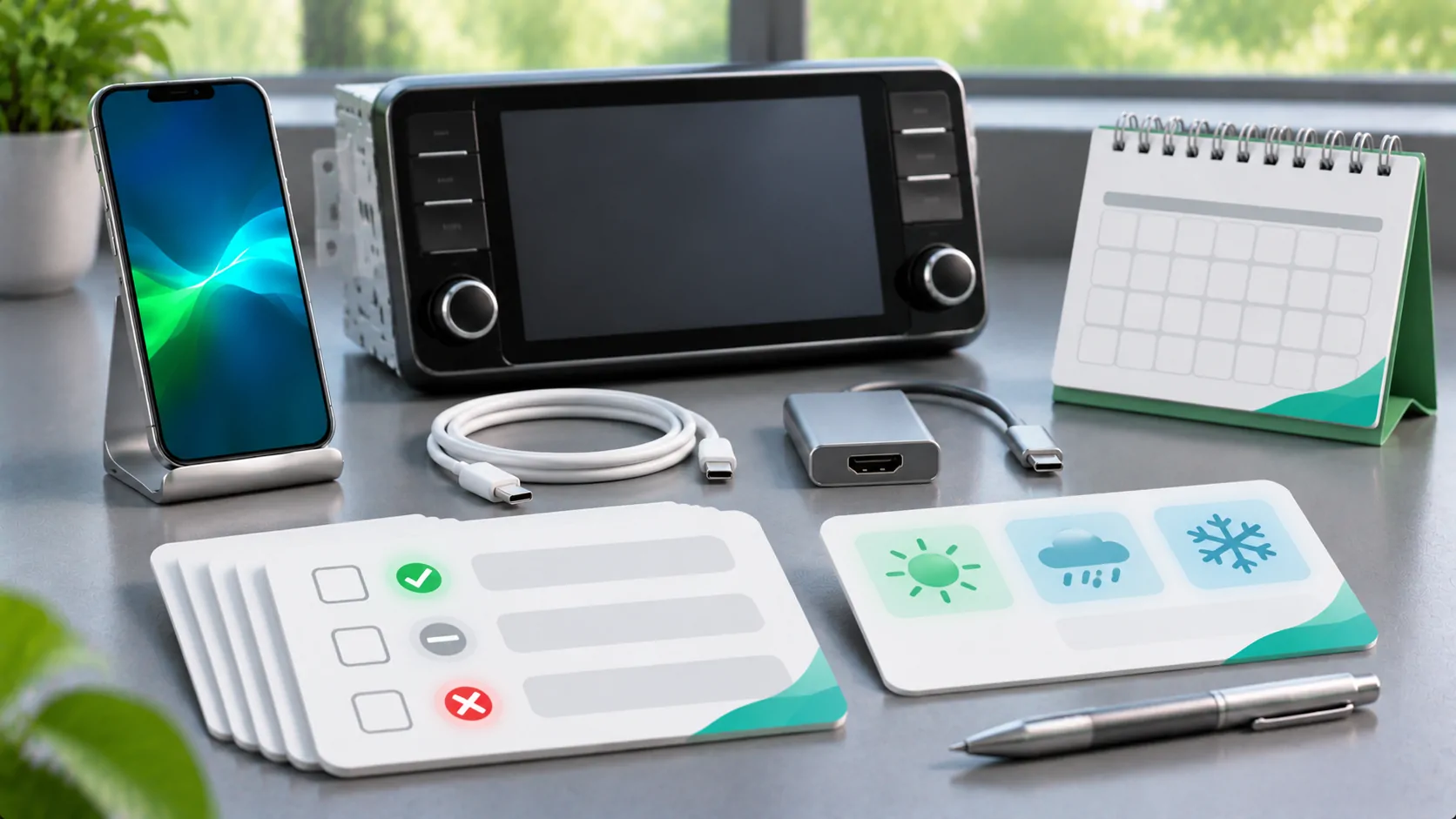
Reliability needs a defined test
Wireless CarPlay reliability can mean successful startup, uninterrupted navigation, stable audio, working calls or recovery after leaving and returning. Those outcomes are related but not identical. Define which one you are tracking before comparing phones, receivers or updates. A single disconnected session does not establish a failure rate, and a successful demonstration does not establish long-term reliability.
This outlook is dated November 6, 2026, with observation windows through February 6, May 6 and November 6, 2027. It identifies signals worth monitoring rather than predicting a numerical improvement or decline. The candidate opportunity is practical diagnosis grounded in version and connection evidence, especially when software or hardware changes create a reproducible difference.
Start from documented connection requirements
Apple's CarPlay setup guide explains the supported connection process, and its troubleshooting guide provides a normal diagnostic starting point. The vehicle manual remains necessary for the receiver's controls and supported wireless implementation. A working Bluetooth audio pairing alone is not proof that a wireless CarPlay session is established.
Record whether the setup is native wireless or an adapter converting existing wired CarPlay. The adapter introduces another device, firmware and startup sequence. Keep those arrangements in different groups when comparing results. Otherwise an apparent phone or vehicle trend may actually reflect the extra component or a change to its power and pairing behavior.
Use denominators and complete configurations
For startup testing, count successful and failed attempts out of the attempts actually performed. Record the time window and definition of success. A result such as eight successful connections in ten attempts describes that limited experiment; it does not estimate all users' experience. Keep sample size visible and avoid percentages that imply more precision than the test supports.
Include phone model, iOS build, public or beta channel, vehicle year, region, receiver version and adapter details. Also record which phone should have connected when several are nearby. Without that context, reports about the same model name can describe different systems. A collection of forum complaints is a useful source of hypotheses, but it has no reliable denominator for an overall failure rate.
Separate symptoms before seeking a common cause
Track interface loss, audio interruption, delayed startup, microphone problems and wrong-phone selection separately. If a map remains visible but sound disappears, record that limited symptom. If the entire CarPlay interface exits, that is another event. A broad disconnected label can hide meaningful differences and lead to a repair that targets the wrong layer.
Ask what happens immediately before the event and what restores service. Did a supported call begin, did another phone enter range, or was the vehicle restarted? These are observations, not established causes. Avoid claiming interference or an operating-system bug solely because one event occurred nearby. A useful test repeats the relevant condition while controlling other variables as far as practical.
Compare updates with a preserved baseline
Before a planned update, run a small parked baseline using normal tasks and the same equipment. After updating one component, repeat those tasks and record the result. If several layers change together, acknowledge that the comparison cannot isolate one cause. Keep iOS, app, receiver and adapter versions separate rather than summarizing them as the latest software.
Where the vehicle supports it, retain a direct wired comparison. If the same phone and receiver work reliably over the direct link but not through an adapter, that narrows the investigation without conclusively identifying a fault. Adapter versus native wireless CarPlay explains why those implementations deserve separate compatibility and maintenance records.
Observe power, temperature and device selection
Phone charging, heat and placement can affect the overall setup, but their role must be tested rather than assumed. Record whether the phone was charging, unusually warm or in a different location. Follow the device and vehicle guidance. Do not move a phone into an unsafe position simply to test a hypothesis about connection quality.
For multi-phone households, check priority and switching controls in the actual receiver or adapter. A system choosing another authorized phone is different from a link that cannot stay connected. Test device removal and reconnection while parked. If the control is unclear, a focused tutorial may be useful without making a broader claim that the underlying wireless technology is unreliable.
Review evidence in three stages
Through February 6, 2027, establish consistent symptom labels and capture official changes and current localized user questions. Through May 6, compare reproducible issues across supported public versions and known receiver configurations where authorized test equipment is available. Keep beta observations separate because their purpose and expected stability differ from public-release use.
Through November 6, reassess whether a problem has a documented resolution, remains configuration-specific or lacks enough evidence. Search-interest data can show attention to an issue, but it cannot measure the technical failure rate. A burst of posts following a release can reflect greater attention as well as a real regression. Do not convert either signal into a universal reliability ranking without suitable data.
Publish a useful diagnosis rather than a forecast claim
The best content opportunity is likely a repeatable decision path: confirm support, identify the active route, reproduce the symptom, check versions and use documented recovery. That is a conditional editorial judgment, not proof that troubleshooting searches will grow. Lower confidence if real localized demand is weak or if the proposed article repeats existing advice without adding a concrete decision.
Use phone and vehicle update boundaries to assign the next support step. Include dates and limits with every test result. Reliability reporting is valuable when another owner can identify whether the evidence applies to their setup, while understanding that an individual observation does not establish how every car, phone or future update will behave.
Sources
Related reading
Bring your own media.
Explore CarCast for iPhone with your own authorized sources and supported display configurations.