CarPlay News
AI Assistants in CarPlay: What to Watch and Verify
Research voice-based conversational apps in CarPlay by verifying official categories, app releases, languages, privacy and real availability instead of assuming universal AI support.
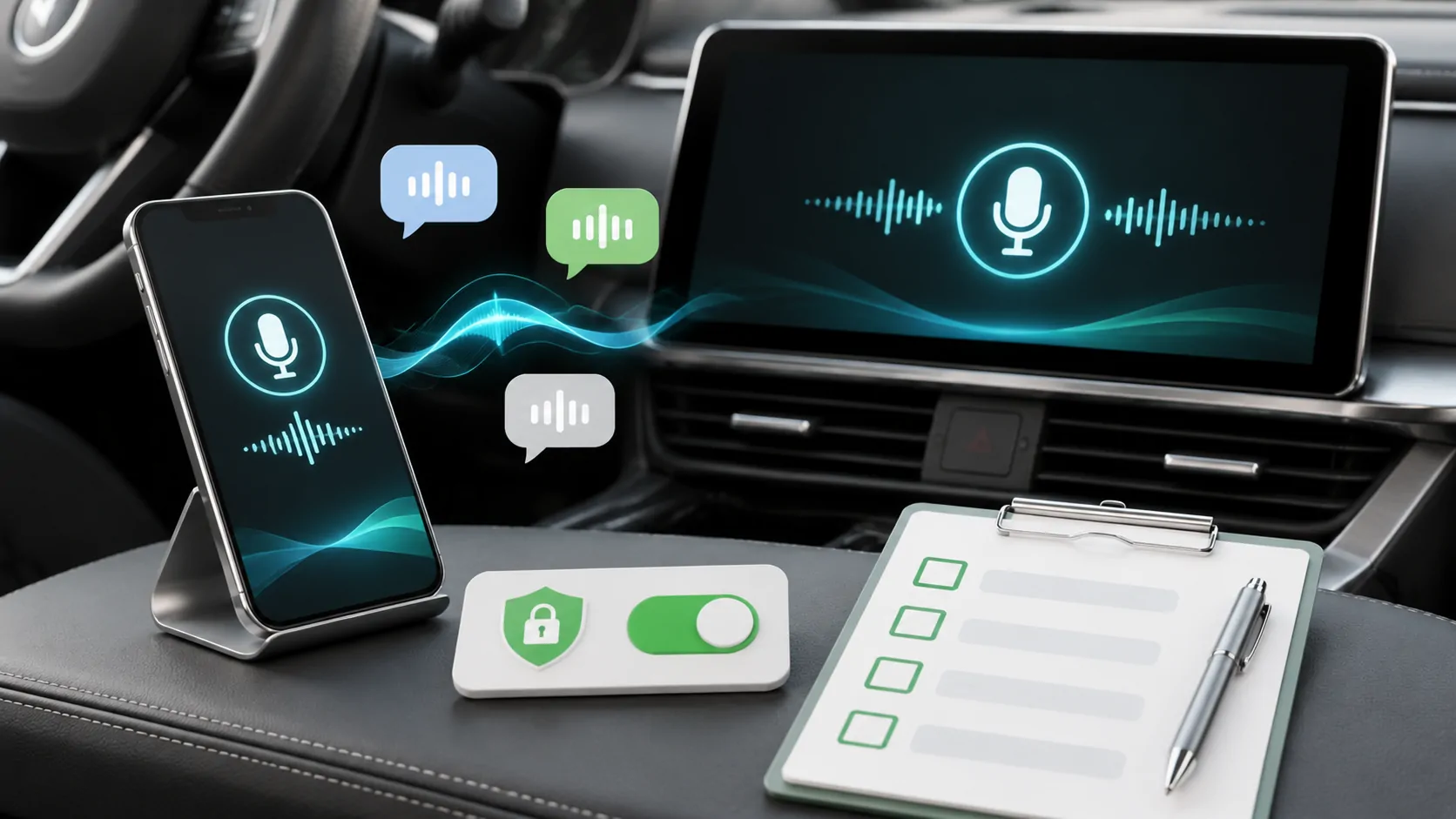
Start with the confirmed category
Apple's current CarPlay developer overview includes voice-based conversational apps among supported categories. That is an official platform signal worth tracking. It does not establish that every AI assistant app appears in CarPlay, that all features are allowed or that any named product is available in every language and market.
This outlook is dated November 6, 2026 and covers observation windows through February 6, May 6 and November 6, 2027. It is a research agenda, not a measured search-growth report. The central expectation is conditional: real releases may create questions about app availability, accounts, microphones, language and permitted interactions. The timing and scale remain unmeasured.
Distinguish the assistant from the integration
An app can offer a conversational service on the iPhone without implementing the corresponding CarPlay experience. A voice feature may also be built into another application rather than distributed as a separate assistant. Identify the exact product, version and route before comparing capabilities. A microphone button in a phone screenshot is not evidence of a CarPlay interface.
Apple's entitlement request process explains why category eligibility and approval matter. Keep the developer's approved capability and distributed release separate from a demo or announcement. For editorial work, record whether the claim comes from official documentation, an app release note or an actual supported test, and avoid collapsing those into a single available label.
Define the task users want to complete
Potential intents include asking a general question, continuing a conversation, finding information or using a task-specific service. These are not necessarily equivalent to controlling the car or replacing its native assistant. Do not infer vehicle control, navigation authority or access to personal data from the existence of a conversational category.
Research what users actually request and what the app documents. A clear availability page may be more useful than a ranked list of assistants with vague capability claims. Separate a general conversational service from actions involving messages, accounts, purchases or vehicle functions. Each can have different authentication, confirmation and supported-interaction requirements that should be verified before describing a workflow.
Treat voice interaction as a privacy workflow
Before recommending an application, examine its microphone permissions, account requirements, privacy policy and supported deletion controls. Determine whether audio or transcripts are sent to a remote service and what the developer says about retention. Do not apply one provider's privacy statement to another product simply because both are described as AI assistants.
Include passengers and shared vehicles in the evaluation. A spoken response can reveal private information even when a screen is not visible, and a persistent account may remain connected between drivers. Check how to end a session and remove access. These are practical product questions that can justify distinct content when supported by current documentation or a controlled test.
Verify language, region and connectivity
Language support can affect both recognition and response, while region can affect distribution, accounts and features. Record those dimensions explicitly. English availability is not proof of availability for another language or country. For multilingual markets, sample local search expressions rather than translating one English phrase and reporting it as observed demand.
Check the app's documented network requirements and failure behavior. A service may need connectivity even when the CarPlay connection itself is working. Distinguish no vehicle interface, no microphone permission, expired sign-in and remote-service failure. A response delay is not enough evidence to identify which component failed. The useful tutorial explains how to recognize each state without inventing a universal fix.
Use the first three months to verify real releases
Through February 6, 2027, collect current official app releases and category documentation. Confirm whether a user can obtain the relevant version and what requirements apply. Use Apple's normal setup guidance for the CarPlay connection, but use the app developer's documentation for assistant behavior. The connection guide does not establish every service's feature set.
Record candidate queries about availability, languages, missing apps and microphone privacy with source and locale. Search suggestions and forum questions can reveal wording, but they do not establish monthly volume or a growth rate. If comparable keyword-tool or analytics data becomes available, store it separately from the editorial forecast and preserve the measurement setup.
Make six- and twelve-month expansion conditional
Through May 6, 2027, publish practical guidance when a real release or documented problem creates a clear task. Through November 6, 2027, reassess whether those tasks persist and whether additional apps or languages have actually become available. Do not create a page for every imagined assistant-brand combination before distribution and support are confirmed.
Delayed releases, limited regions, weak local query evidence or unsupported task claims should lower forecast confidence. Repeated independent user questions alongside shipped functionality would strengthen it. Avoid numerical adoption predictions without suitable data. The goal is to understand which questions become useful to answer, not to declare that every in-car interaction will soon become conversational.
Keep the driving context and claims bounded
Use only supported interactions and follow the vehicle's controls and operating restrictions. Voice interaction does not eliminate distraction or authorize arbitrary tasks while moving. Prepare accounts and permissions while parked, and stop safely before troubleshooting. Do not claim that a conversational app can bypass platform restrictions, access unrelated vehicle systems or replace emergency services.
CarPlay categories and entitlements explains the developer layer, while video availability illustrates how platform and vehicle capabilities differ. Publish assistant guidance with product, version, date, language, region and evidence status. That makes future updates straightforward and gives users a concrete answer even when the current result is a documented limitation.
Sources
Related reading

Bring your own media.
Explore CarCast for iPhone with your own authorized sources and supported display configurations.